Address
304 North Cardinal St.
Dorchester Center, MA 02124
Work Hours
Monday to Friday: 7AM - 7PM
Weekend: 10AM - 5PM

Address
304 North Cardinal St.
Dorchester Center, MA 02124
Work Hours
Monday to Friday: 7AM - 7PM
Weekend: 10AM - 5PM
Building judgement and capability in complex information environments
Building judgement and capability in complex information environments
 ByKayO
This is the supporting post to the QUT Education Faculty Research and Publication (RAP) Week workshop I presented along with my supervisor, Associate Professor Hilary Hughes and Dr Mandy Lupton.
The aim of the workshop was to share my own experiences of researching using social media, and to highlight the value of developing connections and networks as a higher degree research student.
Created using Visme. Free Online Presentation Software.
It is stunning how quickly social media has infiltrated almost every part of our lives. As education researchers, we can take advantage of the potential for social media in many different ways, even if the focus of our research is not directly related to any form of online communication. However before we can begin exploring this area, it is important that there are shared understandings of the terms being used – we use the words ‘internet’, ‘world wide web’ and ‘social media’ so commonly in our everyday parlance, but do we really know exactly what we mean when we say them?
The Internet: The first incarnation of what would become the internet was realised in 1969 when four host computers were networked and referred to as ARPANET (Leiner et al., 2009). Over time, ARPANET expanded to include other disconnected communities of researchers and scholars. Further expansion led to what has become the global infrastructure of computers known the Internet.
The World Wide Web: was first proposed in 1989. It is defined by its founder, Tim Berners-Lee (1996, p. 69) as “the universe of global network-accessible information”. It is essentially the sum of all content available via the network of computers known as the internet. We use information from the WWW everyday –every time we Google, we are accessing the world wide web of information.
Social media: When speaking about researching and collecting data using social media, I am referring to one aspect of the world wide web – social software. Social software are applications hosted within the internet, which are designed to support social networks and conversational interaction between individuals and groups (Boyd, 2003). Also known as social media, social software enables anyone with a connection to the internet to communicate, collaborate, create and share online (Carter & Nugent, 2010).
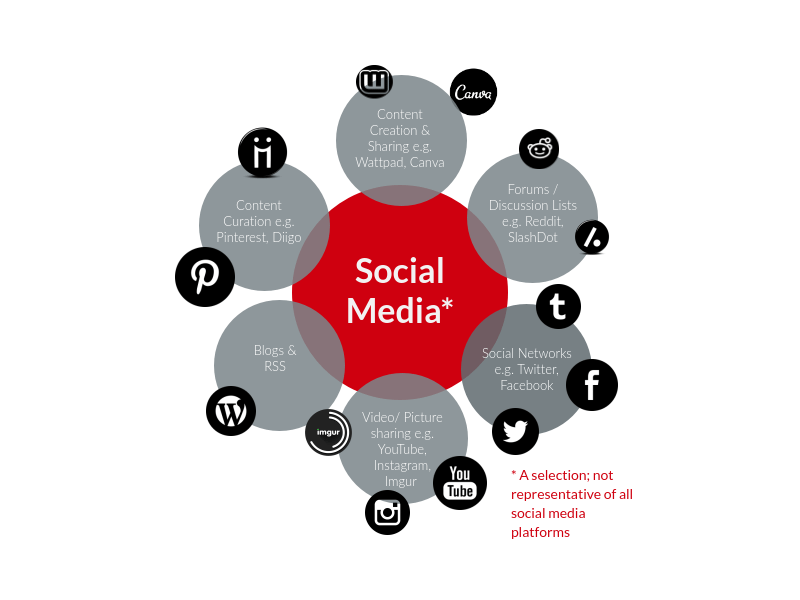
This includes social network services like Facebook, Twitter and Instagram, as well as content curation platforms such as Pinterest and Diigo, blogs, RSS, wikis, content creation and sharing platforms such as Wattpad and Canva, listserves, forums and communities such as Reddit and some aspects of online gaming.
“Social media data is clearly the largest, richest and most dynamic evidence base of human behaviour, bringing new opportunities to understand individuals, groups and society.” Batrinca & Treleaven, 2015, p. 90.
The social media space is relatively new: the phrase Web 2.0, which marked the beginning of the period when social media began to develop was only coined in 1999 (by Darci DiNucci). Facebook was launched on Feb 4 2004, Wikispaces Jan 1 2005 and YouTube August 20 2005. Twitter followed in 2006, Tumblr in 2007 and Pinterest and Instagram in 2010, Google + in 2011. These spaces are all less than 15 years old!
Despite it’s youth, there are already 2.9 billion global social media users in 2017, and growth is still massive – 110 million people started using social media over the first three months of 2017, which is a rate of more than 1 million new users per day – that’s 14 new users every second!
The amount of people using social media generates a huge amount of data. This data can be viewed quantitatively, as in the numbers of people, the number of words, the range of sentiments they express, the geo-location of their posts and more – in fact, large scale data collection and analysis has also been called social listening, and is a huge area of interest for researchers all over the world. However, it is possible to take a qualitative research approach to using social media also – using its potential for human communication and connection to gather the stories of individuals, potentially from audiences who have been traditionally difficult to reach. Social media allows qualitative researchers to have a global reach, and it is this global community that I am accessing in my own research.
I am researching how people learn using social media, and I am using social media to conduct my research.
When social media tools are used to develop a network of connections which support professional learning, this is referred to as a personal learning network. My research is about how teachers experience professional learning through personal learning networks (PLNs). I have been developing my personal learning network since I joined Twitter in 2007, and I find PLNs interesting because they allow people to learn anywhere, about anything, so long as they can connect with the right person, resource or information at the right time.
A short story:
In my previous role at Brisbane Catholic Education, I was the copyright advisor, and spent a lot of time learning about Creative Commons so I could run workshops on it for the staff creating resources. Early one morning, before work had even begun, I encountered a question regarding creative commons that I could not find an answer for. I posted it on Twitter. Within 15 minutes, Lawrence Lessig, who is a Harvard law professor and a leading figure in the entire CC movement contacted me with a response – and I was stunned, star-struck, and had a solution to my problem! There is no way this would never have happened before social software enabled me to connect with people outside my immediate circles, and is just one of many times that I have been overwhelmed by the generosity of wisdom figures who are more than happy to share their knowledge with connections they make online.
I think that through the PLN, there might be potential for teachers who are time poor and who may not be able to access the professional learning relevant to their context easily. Now that we have access to social software, it is easier than ever to create connections with other teachers who might be at different schools in our city, or in our state, country or anywhere in the world. We can connect with researchers, academics, experts in different fields. I hope that through my research we can learn more about the ways that a PLN may enrich professional learning and to explore whether teachers find that it is a good way to engage with professional learning.
I am compiling a collective case study, where I investigate the experiences of different teachers in widely varying contexts across the world, with the aim of using this lived experience to develop a conceptual model of what professional learning looks like when experienced through personal learning networks. I am hoping to gather multiple perspectives, and to explore the complexities of the human experience; not draw conclusions based upon numerical data.
1. Seeking participants
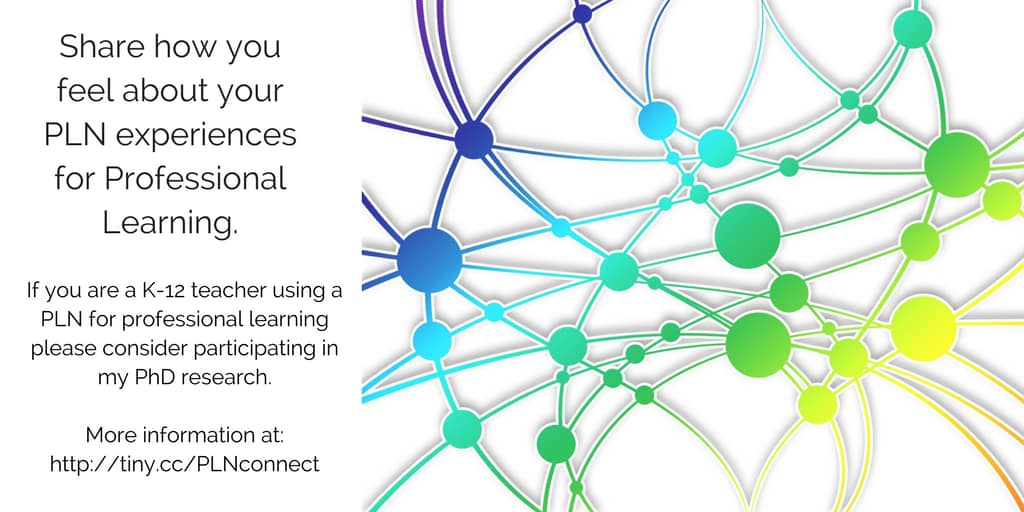
Using social media to seek participants is very powerful! Here is what I have learnt from my experiences:
Create your own space for sharing – but remember the private/public dynamic
You are reading this post on my blog, where I do a lot of my ‘thinking’ and share my reading. My blog gives me opportunities to write about my ideas and explore them with others. I used a page on my blog as a space to direct people who are interested in my research. Having an online form and the official QUT information sheet means that people can get a good idea of what the research is about and indicate their interest in participating anonymously. You need a strategy like this because you can’t have people just reply to your tweet or put a post on Facebook; then they would lose their anonymity by their public response.
Social media is a very public space and so it is important that you think about how you will ensure participants are protected. I use private messaging to some extent but prefer email for official communication because then I can cc in my supervisors, attach the paperwork needed via a private channel.
As a tool for data collection
As I am conducting qualitative research, I am asking participants to sketch a map of their PLN and then I am meeting with them for semi-structured interviews. Having participants recruited through social media means that they can come from all over the world! This is awesome, but also brings challenges:

There are a lot of ethical issues to consider when using social media for research.
Three major areas of ethical concern are outlined by Gerber, Abrams, Curwood, & Magnifico, in their excellent text, Conducting Qualitative Research of Learning in Online Spaces:
These are intertwined, and are best explained through example. In my own research, I would love to conduct a Twitter chat, asking participants for their experiences of professional learning through their online networks. However, this online space is difficult to control. Even if I outlined at the beginning of the chat that I would be collecting the data for my research, the Twitter space is essentially open and anyone can join at any time, so there is a very good chance that participants may join the chat who have not seen this announcement – is this therefore private or public information?
Twitter is a public medium, so perhaps it could be argued that the tweets were ‘public’ but would the case be the same if we were within a closed Facebook group?
Consent in a Twitter chat may be impossible to obtain. People tend float in and out of twitter chats, and although I might be able to go through and contact participants afterwards, this would be consent gained after the fact. and therefore the participants would not have been sharing information with from a position of informed consent. There is also a strong chance I may not be able to make contact with a person privately, as people can configure their accounts so you can only privately message if following each other. Seeking consent publicly would almost definitely infringe on confidentiality.
Although my own topic is something not many minors would be interested in, consider if my topic was with reference to gamification using Minecraft, or if I was chatting within a guild with a gaming community – in these scenarios, there may be a chance that participants could be minors, for whom I may need parental consent.
As you can see, although some forms of data collection may sound fabulous in theory, there are many aspects that need examination from an ethical standpoint. This does not mean that they are impossible to employ – just that they may require a little more planning and consideration of how such ethical issues might be managed.
But don’t let this put you off! Researching using social media is a fascinating area, and there is a growing range of resources available to support the development of ethical social media research!
To support this workshop, I have curated a range of resources and people who are working within the area. You can follow up with this information by checking out my ELink page, embedded below, or going directly to it.
Although I have linked to references within this post, here are the details again so that you can read further if you are interested:
Batrinca, B., & Treleaven, P. C. (2015). Social media analytics: A survey of techniques, tools and platforms. AI & SOCIETY, 30(1), 89-116. doi:10.1007/s00146-014-0549-4
Berners-Lee, T. (1996). WWW: past, present, and future. Computer, 29(10), 69-77. doi:10.1109/2.539724
Boyd, S. (2003, 2006-02-06). Are You Ready for Social Software? . Darwin Magazine. Retrieved from http://web.archive.org/web/20060206092704/http://www.darwinmag.com/read/050103/social.html
Carter, T. J., & Nugent, J. S. (2010). Personal learning networks: Implications for self-directed learning in the digital age. In V. C. X. Wang (Ed.), Encyclopedia of Information Communication Technologies and Adult Education Integration (pp. 226-240). USA: Information Science Reference.
Gerber, H. R., Abrams, S. S., Curwood, J. S., & Magnifico, A. (2017). Conducting qualitative research of learning in online spaces. Thousand Oaks, California: Sage Publications, Inc.
Leiner, B., Cerf, V., Clark, D., Kahn, R., Kleinrock, L., Lynch, D., Postel, J., Roberts, L., & Wolff, S. (2009). A brief history of the internet, 39, 22-31. doi:10.1145/1629607.1629613